Key takeaways: At typical Indian home tariffs (₹6–9 per unit), an electric car costs roughly ₹1–₹1.5 per km to run — about one-sixth of a petrol car. Public DC fast charging (₹18–25 per unit) pushes that to ₹2.5–₹3.5 per km, still far cheaper than petrol's ₹6–₹8. Your biggest lever is your state's electricity tariff, not your driving style. This timing matters: EVs took a 10.5% share of Navratri vehicle registrations in October 2026, and thousands of those new buyers will face the home-vs-public charging question in their first month of ownership.
Where the per-km gap comes from
An EV's running cost is just three things multiplied together: how much energy the car uses per km, how much each unit of electricity costs you, and how much energy is lost as heat while charging. Home AC charging runs through your car's onboard charger at roughly 85–88% efficiency, so a 40 kWh top-up draws about 44–46 units from the meter. Public DC fast chargers convert AC to DC at the station itself, so they are 90–95% efficient — but the tariff is two to three times higher, which swamps the efficiency advantage completely.
Here is what the market looked like in October 2026:
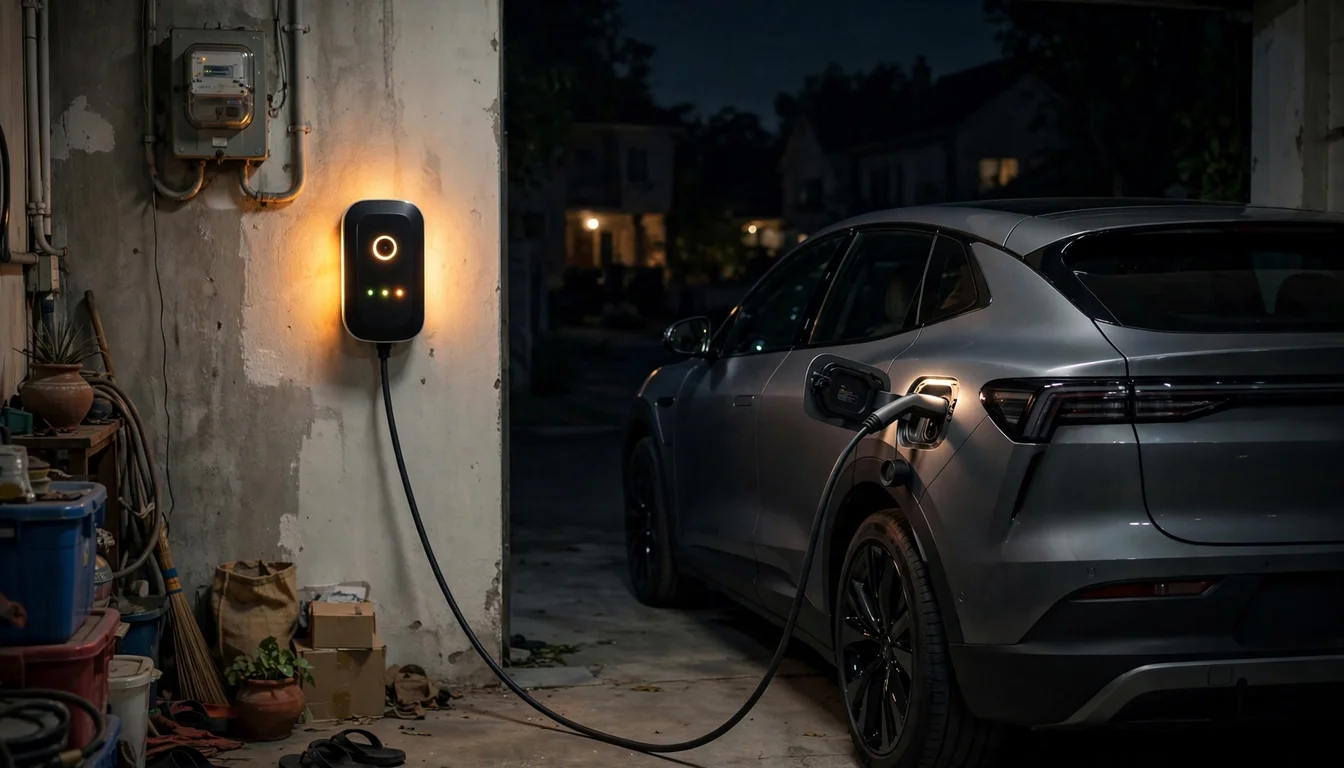
- Home AC charging (15A socket or 3.3–7.4 kW wallbox) — ₹6–₹9 per unit: about ₹1–₹1.5 per km. Best for daily overnight charging; this is how over 80% of Indian EV owners actually charge.
- Public AC charging (malls, workplaces, slow stations) — ₹10–₹15 per unit: about ₹1.5–₹2.2 per km. Good for workplace top-ups.
- Public DC fast charging (highways, city fast hubs) — ₹18–₹25 per unit: about ₹2.5–₹3.5 per km. Best for intercity trips and emergency top-ups, not daily use.
Some networks price below ₹18 per unit on subscription or promotional rates, and premium highway sites occasionally go above ₹25. Always check in the charging app whether the displayed rate includes GST, and whether the site adds idle or parking fees — malls in Delhi, Mumbai and Bengaluru routinely add ₹100–₹300 in parking that quietly inflates a long session's "per km" cost.
Your state's tariff matters more than your car
Unlike petrol, where ₹105-ish per litre is broadly similar across cities, electricity tariffs are set by each state's DISCOM and vary dramatically. At the same car and the same driving, your cost per km changes with your pin code:
- Delhi — around ₹4.5 per unit: full 40 kWh charge for roughly ₹180, working out to about ₹0.72 per km.
- Karnataka — ₹5–₹7 per unit: full charge ₹200–₹280, roughly ₹0.9–₹1.1 per km.
- Maharashtra — ₹6–₹8 per unit: full charge ₹240–₹320, roughly ₹1–₹1.3 per km.
- Tamil Nadu — ₹5–₹9 per unit: full charge ₹200–₹360, roughly ₹0.9–₹1.4 per km.
- Uttar Pradesh — ₹8–₹10 per unit: full charge ₹320–₹400, roughly ₹1.3–₹1.6 per km.
Several states also offer concessional EV tariffs as low as ₹3–₹4 per unit, and a few DISCOMs provide a separate EV meter so your charging stays out of your household slab — worth asking your DISCOM before you assume the domestic slab rate. Slab creep is the hidden trap: EV charging adds 150–200 units a month, which can push your household into a higher slab and raise the effective rate on every unit, not just the car's.
Worked example: 1,200 km a month in a Tata Nexon EV
Take the country's best-selling electric car, the Nexon EV 45, at a middle-of-the-road home tariff of ₹8 per unit. A 10–80% top-up adds roughly 31.5 kWh of energy. With charging losses, the meter sees about 35 units.
- At home (₹8 per unit): about ₹280 for the top-up. Over 1,200 km a month, total charging comes to roughly ₹1,200–₹1,440 — around ₹1 per km.
- At a public DC fast charger (₹20 per unit): the same top-up costs about ₹630. Over 1,200 km, roughly ₹3,200 a month — around ₹2.6 per km.
- Equivalent petrol SUV (14 km/l at ₹100/litre): about ₹8,570 a month — roughly ₹7.1 per km.
So home charging saves roughly ₹7,300 a month over petrol, and even public-fast-charging EV use saves roughly ₹5,300. The golden rule holds either way: charge at home whenever you can, and treat public fast charging as a travel tool.
When public charging is the right choice
Home charging wins on cost, but it does not work for everyone. Apartments without dedicated parking, societies that refuse wallbox installations, and regular intercity drivers all need public charging — and it is still a good deal if you use it smartly:
- Prefer public AC over DC fast charging when you have time: ₹10–₹15 per unit is meaningfully cheaper than ₹18–₹25, and slower charging is gentler on the battery.
- Check the full session price before plugging in: energy tariff + GST inclusion + parking + idle fees. Aggregator apps like Tata.ev, Zeon Charging, Statiq, ChargeZone and PlugShare show most of this up front.
- Use workplace charging: many employers subsidise or fully cover charging as a staff benefit. For a daily commuter, this alone can bring monthly fuel cost close to zero.
- Reserve DC fast charging for highways: a 10–80% top-up takes 30–60 minutes at 25–150 kW. For that speed premium you are paying for time, not energy — on a long trip it is worth it; for daily commuting it is not.
Four ways to push your home per-km cost even lower
- Apply for a dedicated EV meter or EV tariff: concessional rates of ₹3–₹4 per unit exist in several states and can cut home charging cost nearly in half. One call to your DISCOM's helpline tells you if your circle offers one.
- Sort out society permission early: apartment residents in independent houses need no permission, but society residents need it for a wallbox. Raise it before delivery day, not after — this is the single most common source of new-owner frustration in 2026.
- Charge overnight on a 15A socket if you are a light user: a 3.3 kW portable charger adds 40–60 km of range overnight and needs no installation beyond a good 15A socket. The 7.4 kW wallbox (₹40,000–₹80,000 installed) pays for itself only if you drive 100+ km daily.
- Pair with rooftop solar if you already have panels: daytime charging on surplus solar power drops the marginal cost of a km close to zero, once the panels are installed.
Frequently Asked Questions
How much does it cost to charge an electric car at home in India per month?
For a typical driver covering 1,000–1,200 km a month, expect roughly 150–180 units of electricity. At a home tariff of ₹6–₹9 per unit, that is about ₹1,000–₹2,000 a month. Electric scooters cost far less — roughly ₹200–₹300 a month for equivalent commuting.
Is home charging really cheaper than public charging in India?
Yes — roughly two to three times cheaper per unit. Home charging runs ₹6–₹9 per unit versus ₹18–₹25 at public DC fast chargers. On a per-km basis, that is about ₹1–₹1.5 at home versus ₹2.5–₹3.5 on public fast charging. Even at the worst public rate, an EV stays meaningfully cheaper than petrol.
How many units of electricity does a full charge use?
Roughly your battery size plus 10–12% for charging losses. A 30 kWh battery draws about 33–34 units from the meter, a 40 kWh battery about 44–46 units, and a 75 kWh battery about 83–87 units. One "unit" on your electricity bill is exactly 1 kWh.
Will charging an EV push my electricity bill into a higher slab?
It can. EV charging adds 150–200 units a month, which may push your household into a higher slab, raising the effective rate on your whole bill. Ask your DISCOM about a separate EV meter or a dedicated EV tariff — several states offer concessional rates of ₹3–₹4 per unit precisely to avoid this problem.
How much does a public fast-charging session cost for a Tata Nexon EV?
Taking the 45 kWh variant from 10% to 80% adds about 31.5 kWh. At ₹20 per unit, that is roughly ₹630 — enough for 200+ km of driving. The same top-up at home costs roughly ₹250. Watch for GST, parking charges and idle fees that some networks add on top.
People also search for
- ev charging cost per km india — the headline question this guide answers
- home ev charger installation cost india — the one-time setup cost behind the per-km number
- ev vs petrol running cost india — full 5-year comparison including resale
- ev battery replacement cost india — the long-term cost question after running cost
- electric scooter charging cost per month india — roughly ₹200–₹300 for a 1,000 km commute
- public ev charging station rates india 2026 — DC fast: ₹18–₹25 per unit on major networks
- separate electricity meter for ev charging india — ask your DISCOM; avoids slab creep
- ev charging during off-peak hours india — some DISCOMs offer night discounts; check locally
Sources & References
- The Hindu BusinessLine — "Electric car sales rise 26% during Navratri, outperform non-EV vehicles" (Oct 2026) — https://www.thehindubusinessline.com/companies/electric-car-sales-rise-26-during-navratri-outperform-non-ev-vehicles/article71607975.ece
- EconoTimes — "Electric Vehicles Reach 10.5% Share of India's Navratri Registrations" (Oct 2026) — https://econotimes.com/Electric-Vehicles-Reach-10-5-Share-of-India-s-Navratri-Registrations-1759521
- LiveMint — "Planning to go green? Do solar panels and EV chargers actually slash your utility bills?" (Oct 2026) — https://www.livemint.com/money/planning-to-go-green-do-solar-panels-and-ev-chargers-actually-slash-your-utility-bills-and-save-you-money-decoded-11792562770766.html
- Kazam — "How Much Electricity Does It Take To Charge An Electric Car?" — https://kazam.energy/category/blog/how-much-electricity-does-it-take-to-charge-an-electric-car
- EarthtronEV — "How to Pay for EV Charging in India: Apps, UPI & Cost" — https://www.earthtronev.com/how-do-you-pay-for-charging-an-electric-car-at-the-charging-stations/
- Exicom — "Do You Have to Pay for Parking When Charging Your EV?" (2026 guide) — https://www.exicom.com/insights/blogs/ev-charging-parking-costs-guide
- EV Community — "EV vs Petrol Car India (2026): Which is Cheaper?" — https://evcommunity.in/ev-vs-petrol-car-india-2026/