TL;DR
- What happened: the Union Ministry of Panchayati Raj (MoPR) and Convergence Energy Services Limited (CESL) have signed an MoU to develop EV charging and battery-swapping stations on panchayat-owned land across India.
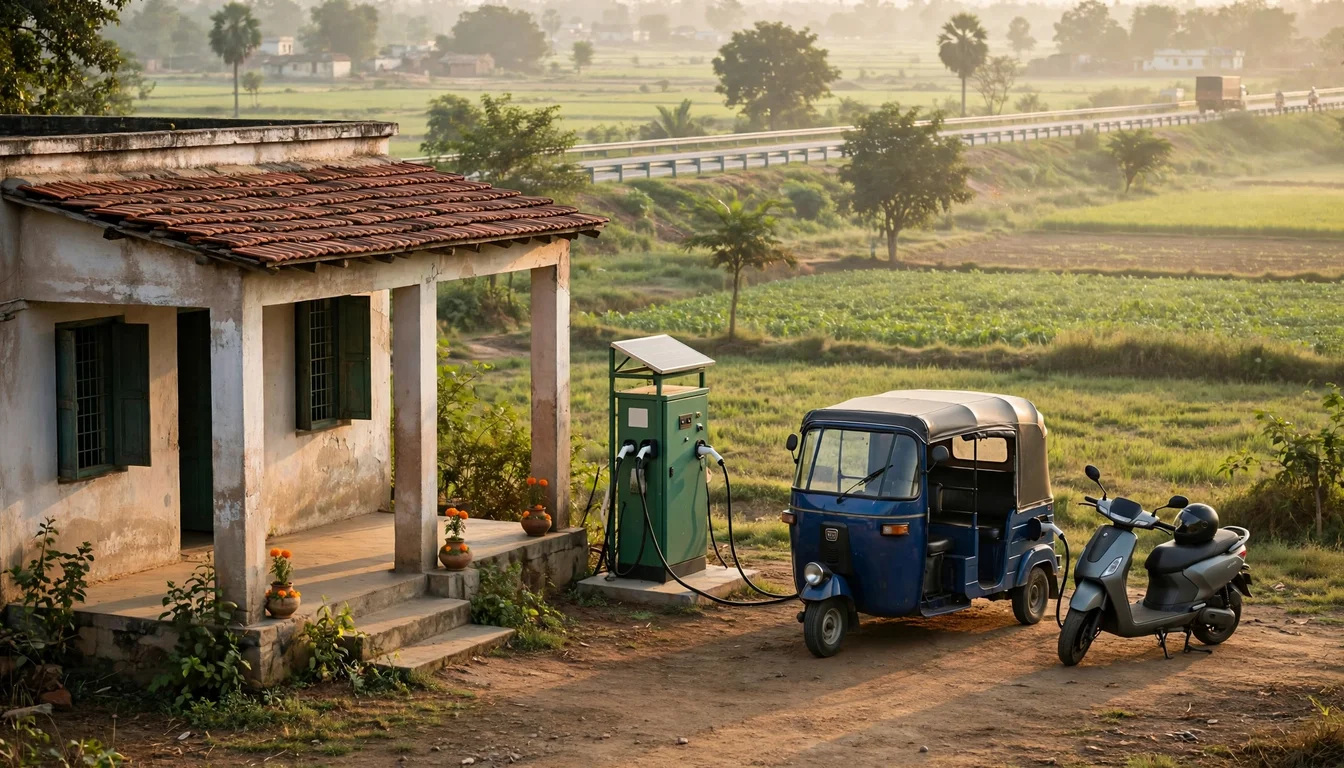
- Where: panchayat premises and suitable panchayat land along State and National Highways, for two-wheelers, three-wheelers, cars and medium and heavy commercial vehicles.
- Panchayat income: reported estimates put a small station at around ₹3,000 a month and a large one at around ₹10,000 a month, plus ₹1 per unit of electricity billed under Power Ministry guidelines.
- Not decided yet: no station count, first states, rollout timeline or budget has been announced. This is a framework agreement, not a finished network.
The deal, in plain terms
The MoU was exchanged in New Delhi on 30 October 2026 and announced on 31 October 2026, by Mukta Shekhar (Ministry of Panchayati Raj) and Akhilesh Kumar Dixit (CESL), in the presence of Union Minister Rajiv Ranjan Singh. CESL is a wholly owned subsidiary of Energy Efficiency Services Limited (EESL), under the Ministry of Power — the rural-governance ministry supplies the land, the power ministry's arm supplies the charging know-how.
The division of labour is the most concrete part of the announcement:
- Ministry of Panchayati Raj — find and monitor the sites: it will coordinate with State Panchayati Raj Departments to identify and monitor suitable sites, and will write to states to arrange village-level land.
- CESL — assess, build and run the facilities: CESL will handle site assessment, demand aggregation, installation, commissioning, operation and maintenance at selected sites.
That split is deliberate: panchayats own scattered public land but run no charging networks, while CESL runs charging programmes but owns no village land. The MoU also sits alongside the new Model OSR Rules for transparent panchayat revenue.
Why rural charging is the missing piece
India's public charging story so far is urban and highway-based. September 2026 was a record month — 3,33,571 EVs registered, including 2,07,314 electric two-wheelers — yet most public chargers sit in cities and on a few busy corridors, while villages and small towns have far fewer.
For rural owners, the consequences are familiar: many villages still run on single-phase supply, outages make overnight charging unreliable, a household-socket charger is too slow for a commercial e-rickshaw, and one village rarely generates enough sessions to repay a fast charger.
Panchayat land changes the economics twice over: it removes the biggest fixed cost, land rent, and CESL's demand aggregation bundles many small sites into one programme instead of negotiating village by village.
What panchayats could actually earn
This is the part most headlines will overstate, so here are the reported numbers with their caveats:
- ₹1 per unit: under Union Power Ministry guidelines, the concerned panchayat will receive ₹1 for every unit of electricity billed at charging and battery-swapping stations, according to officials quoted in the announcement coverage.
- Small station — around ₹3,000 a month: an initial estimate for a station covering roughly 10 x 10 square metres.
- Large station — around ₹10,000 a month: an estimate for a station spread over roughly 20 x 25 square metres, or about ₹1.20 lakh a year.
- What the money is for: officials say the income could fund roads, panchayat ghars, streetlights and cleanliness.
Read those figures as planning estimates, not promised income: they depend on how much electricity the station sells, which turns on local EV numbers, charger size, grid reliability and price. A highway site will sell far more than a low-traffic village site, so panchayats should get the metering and payment schedule in writing.
Charging vs swapping: which one fits villages?
The MoU covers both, and the difference matters more in rural India than in cities:
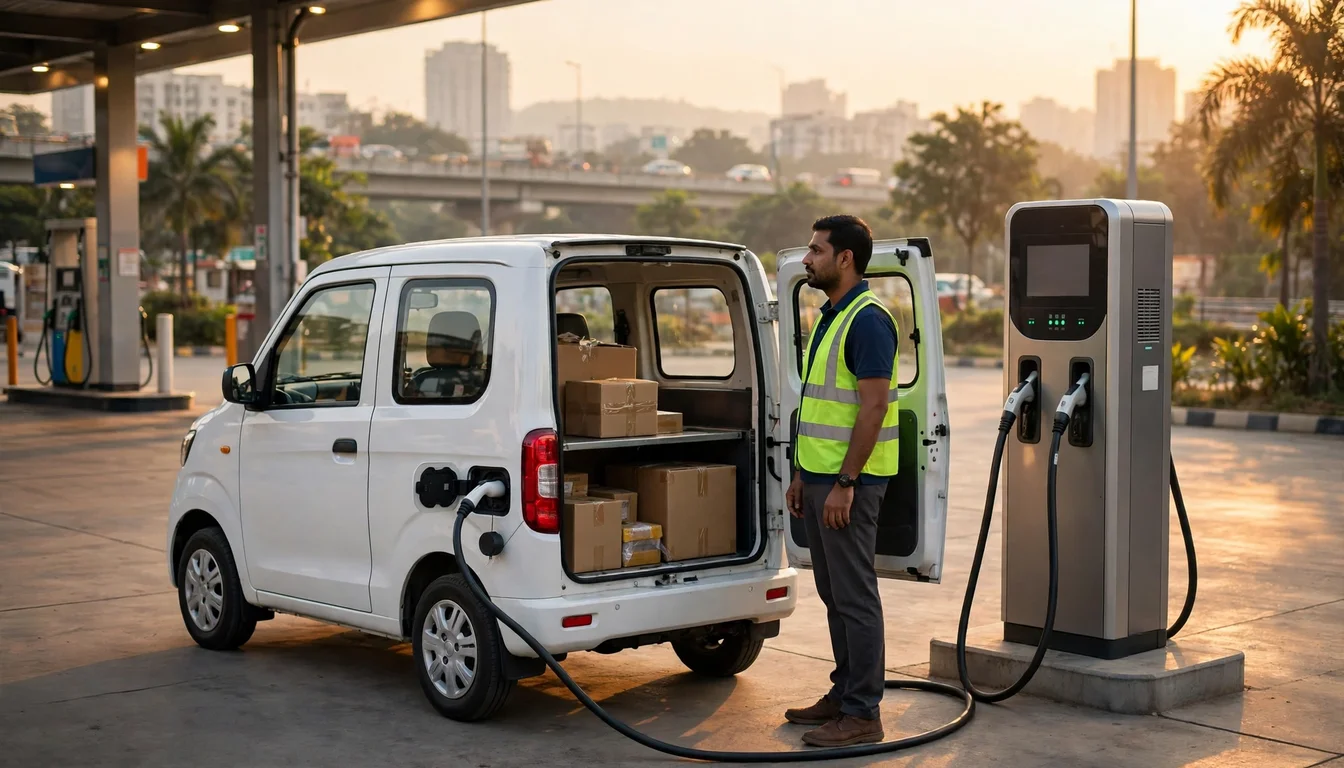
- Charging — you wait while the battery fills: a slow AC charger suits overnight stops; a DC fast charger suits highway stops. Charging works for every EV but needs a decent grid connection, and the driver must wait.
- Swapping — you exchange a drained battery for a charged one: this suits two-wheelers and three-wheelers best, as their batteries are small enough to handle. It cuts waiting to minutes and lets a small kiosk serve a village, but only works where vehicle and batteries are compatible.
Expect swapping to matter most for e-rickshaws and delivery scooters on fixed routes, and charging for cars and highway traffic. Which sites get which is not in the MoU; it will emerge from CESL's site assessments.
The hard parts nobody has announced yet
A framework MoU is the easiest step. Judge the programme on these open questions:
- Grid capacity: fast charging needs a stronger connection than many village feeders provide. Who pays for a feeder upgrade, and how long does it take? Not announced.
- Charger mix: will village sites get slow AC chargers, DC fast chargers, swapping kiosks, or a mix? Not published.
- Pricing for users: public charging typically costs far more per unit than home charging — a September 2026 snapshot put the median listed public DC price at ₹17.99 per kWh — and the MoU announces no rural tariff.
- Maintenance in remote locations: a charger that breaks and waits weeks for a technician is worse than no charger. CESL owns maintenance on paper; response times are unproven.
- First sites and dates: no state, district, station or completion date has been named. Until CESL publishes a site list, nobody can say whether their village is in the first wave or the fifth.
What to do now
- Rural EV owners: keep home charging as your base plan; treat panchayat stations as a top-up option when they arrive. For swapping, check whether your battery system is swappable at all — most private scooters are not.
- Village EV buyers: do not buy on the promise of a future panchayat charger. Buy on today's reality — your home socket, the nearest existing charger, and your daily distance.
- Panchayat members: if offered a site, ask for the charger type, grid work, metering and payment schedule for the ₹1-per-unit income, and who maintains the station. A highway-facing plot earns more than an interior plot.
- Highway drivers: until a site list exists, keep using existing charging apps and plan stops in towns.
Frequently Asked Questions
What did the Panchayati Raj Ministry and CESL actually agree?
They signed a framework MoU to develop EV charging and battery-swapping stations on panchayat-owned land. The ministry coordinates with states to identify and monitor sites; CESL assesses, builds, operates and maintains the facilities. It is a cooperation framework, not a completed network.
How much money can a panchayat earn from an EV charging station?
Under Power Ministry guidelines, the panchayat receives ₹1 per unit billed at the station, officials said. Early estimates put a small station (about 10 x 10 metres) at around ₹3,000 a month and a large station (about 20 x 25 metres) at around ₹10,000 a month, or about ₹1.20 lakh a year. These are estimates, not guaranteed income.
When will the first rural charging stations open, and where?
No date, state, district or station count has been announced. The MoU was exchanged on 30 October 2026 and announced on 31 October 2026; the next step is site identification with states. Until CESL publishes a site list, no one can say when a particular village will get a station.
What is the difference between EV charging and battery swapping?
Charging fills your own battery while you wait; swapping replaces a drained battery with a charged one in minutes, where vehicle and battery are compatible. Swapping suits e-rickshaws and scooters on fixed routes; charging suits cars and highway traffic. Most private scooters are not built for swapping.
How much will it cost a rural driver to charge at a panchayat station?
No rural tariff has been announced. As a benchmark, a September 2026 snapshot put the median listed public DC price at ₹17.99 per kWh, far above home tariffs. Check the operator's app or displayed price before a session.
People also search for
- Rural EV charging stations India
- CESL EV charging stations
- Panchayat EV charging station income
- EV charging in villages India
- Battery swapping stations India
- EV charging cost per km in India
- Home EV charger installation cost in India
- PM E-DRIVE subsidy 2026
Sources & References
- The Hindu, "Panchayat land to power rural EV push under Centre-CESL pact" — https://www.thehindu.com/news/national/andhra-pradesh/panchayat-land-to-power-rural-ev-push-under-centre-cesl-pact/article71650108.ece
- Business Standard, "Panchayats to provide land for EV charging stations in rural areas" — https://www.business-standard.com/amp/india-news/panchayat-land-ev-charging-battery-swapping-cesl-mou-126103100607_1.html
- ETV Bharat, "Centre Partners With CESL To Build EV Charging Stations On Panchayat Land" — https://www.etvbharat.com/en/bharat/centre-partners-with-cesl-to-build-ev-charging-stations-on-panchayat-land-enn26103105214
- The New Indian Express, "Panchayati Raj Ministry signs MoU with CESL; aims to set up EV charging stations across India" — https://www.newindianexpress.com/india/2026/Oct/31/panchayati-raj-ministry-signs-mou-with-cesl-aims-to-set-up-ev-charging-stations-across-india
- Rural Voice, "EV Charging and Battery Swapping Stations to Come Up on Panchayat Land, MoU Signed with CESL" — https://eng.ruralvoice.in/national/ev-charging-and-battery-swapping-stations-to-come-up-on-panchayat-land-mou-signed-with-cesl.html