TL;DR
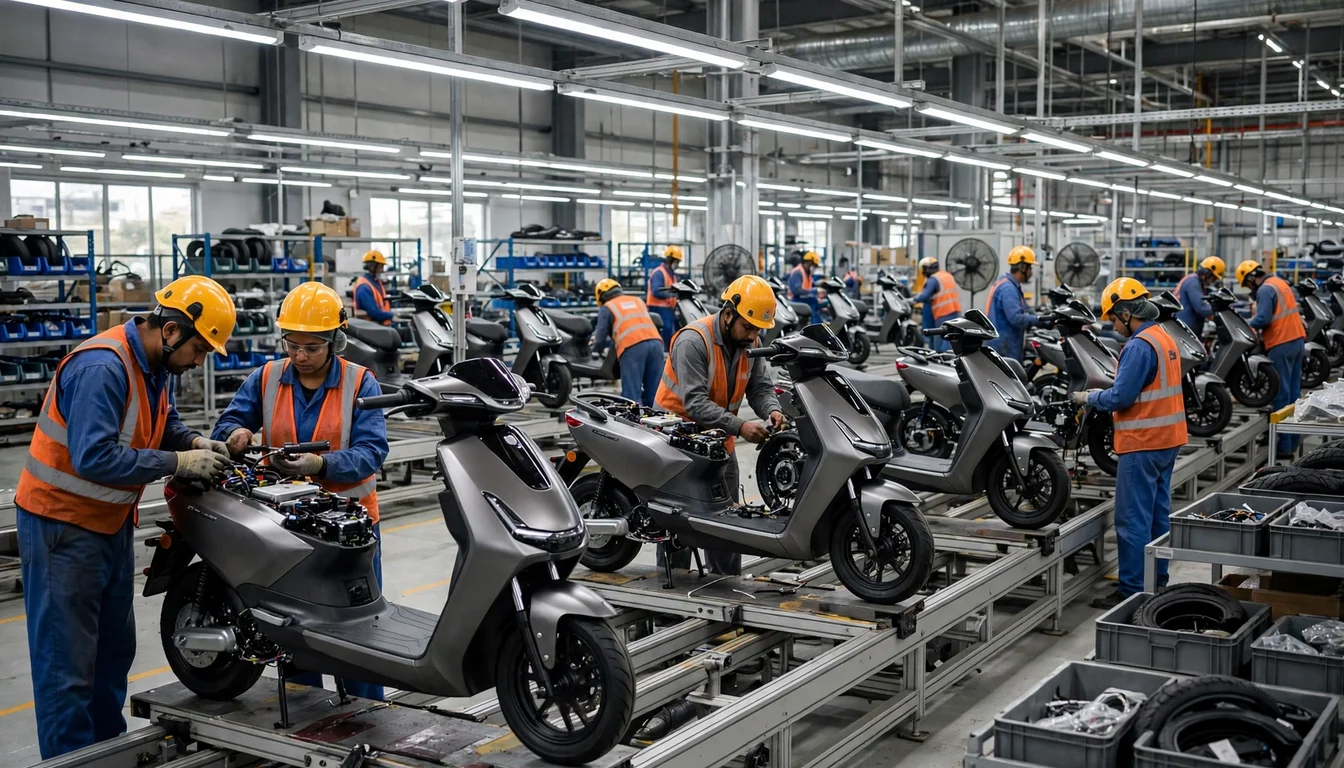
- TVS Motor will raise electric two-wheeler capacity to 80,000 units a month by March 2027, up from 60,000–65,000 units a month today.
- Demand is the driver: TVS sold 1,86,186 electric two-wheelers in the July–September 2026 quarter, more than double the 80,009 units of a year earlier.
- Electric scooters have crossed 20% of India's scooter market, while electric vehicles are 11–12% of the overall two-wheeler market, according to TVS chief executive KN Radhakrishnan.
- Rivals are expanding too: Bajaj Auto is working towards 80,000 Chetak units, and Ather Energy is expanding beyond 41,000 units plus building a new facility.
- Buyer takeaway: more factory capacity should mean shorter waiting periods and better availability of popular variants. Still check variant, range and on-road price before booking.
The announcement in numbers
TVS Motor Company told investors on 29 October 2026 that it is already operating at 60,000–65,000 electric two-wheelers a month and has planned the next level of expansion to about 80,000 units a month by the end of March 2027. The plan was reported by PTI via The Economic Times.
- Current capacity — 60,000–65,000 units a month: the level TVS says it is operating at now.
- Target capacity — 80,000 units a month by March 2027: roughly a 23–33% increase over today's run rate.
- Q2 FY27 electric two-wheeler volumes — 1,86,186 units: up from 80,009 units in the same quarter last year, more than a twofold jump.
- Domestic electric two-wheeler growth — 129% in the quarter: ahead of the industry's 84% volume growth in the same period.
- Industry growth — nearly 75% in the first half of FY27: TVS says electric two-wheelers have kept a strong trajectory, and it expects the momentum to continue in the second half.
TVS is currently the market leader in electric two-wheelers in India, and management told investors it expects to keep growing much ahead of the market. The extra capacity, the company says, will help it cater to demand as sales expand.
Why TVS is expanding now
The expansion is a response to demand that is already visible in registration data, not a bet on a distant future.
- September 2026 was a record month: India registered 3,33,571 electric vehicles, and electric two-wheelers accounted for 2,07,314 of them, with two-wheeler EV penetration rising to 11.6% from 10.7% in August.
- Festive demand was strong: during the 10-day Navratri period (11–20 October 2026), electric two-wheeler retail sales rose 33.41% to 75,758 units, from 56,787 units a year earlier, according to FADA data.
- Scooters are the tipping point: electric penetration in the scooter segment alone has crossed 20%, even though the overall two-wheeler figure is 11–12%. Scooters are where first-time EV buyers actually convert.
- Supply is the bottleneck: festive-season reporting noted dealers facing waiting periods of up to eight months for some models across the industry, driven by higher demand and chip shortages.
What it means for buyers
If you are planning to buy an electric scooter in the next six months, the capacity expansion matters in four practical ways.
- Shorter waits, eventually: capacity added by March 2027 will not clear today's backlog overnight, but it should reduce waiting periods for high-demand variants through 2027. If a dealer quotes a long wait today, ask whether it is a production constraint or a variant-specific shortage.
- Prices are unlikely to fall because of capacity alone: TVS has not linked the expansion to price cuts. The iQube range starts at ₹94,434 (ex-showroom, 2.3 kWh variant) and goes up to ₹1,58,834 (ST 5.3 kWh variant), according to TVS Motor's own site, with on-road prices varying by city, RTO and insurance.
- Running costs stay the big advantage: TVS quotes a running cost of ₹0.18 per km for the iQube, based on its own assumptions of petrol at ₹100 a litre, 50 kmpl and electricity at ₹7.5 per unit. Your actual figure depends on your tariff and riding pattern, but the gap with petrol scooters remains wide.
One caution from our earlier reporting: battery replacement is the long-term cost to watch. A genuine TVS iQube battery pack carries an MRP of ₹34,077, so factor battery health and warranty into any used-scooter purchase.
The competition is expanding at the same time
TVS is not expanding in a vacuum. Its two main rivals have announced matching moves, which means 2027 should be a year of better availability across brands, not just one.
- Bajaj Auto — Chetak capacity towards 80,000 units: Bajaj is working to raise Chetak production to the same 80,000-a-month mark TVS is targeting.
- Ather Energy — beyond 41,000 units, plus a new facility: Ather is expanding capacity at its existing facility to more than 41,000 units and is also developing a new facility.
- What this means for buyers: when all three leaders add capacity together, waiting periods should fall across the segment, and dealers will have to compete harder on delivery timelines, exchange offers and service rather than simply allocating scarce stock.
What to check before you book
Capacity news should not change your shortlist, but it should change how you buy. Use this checklist at the dealership.
- Battery size vs your daily run: the iQube range spans 2.3 kWh to 5.3 kWh, with up to 212 km of IDC range on the top variant. Match the battery to your real daily distance, not the headline range figure.
- Charging at home: the iQube's portable 950W charger plugs into a standard socket and takes the battery from 0 to 80% in 4 hours 18 minutes, according to TVS. Confirm you have a usable socket where you park before booking.
- On-road price in your city: ex-showroom prices are only the starting point. One dealer listing puts the iQube 2.3 kWh on-road price at about ₹1,26,712 in some cities, with the top ST 5.3 kWh variant at about ₹1,85,037 — but RTO and insurance vary, so get your city's written quote.
- Delivery date in writing: with capacity ramping up to March 2027, get the expected delivery month written into the booking, along with what happens to your booking amount if it slips.
- Service network: TVS lists 2,800+ dealers across 1,000+ cities. Check that your city has a trained service point, because electric scooters still need software updates, brake work and battery diagnostics.
Frequently Asked Questions
How many electric two-wheelers does TVS make per month now?
TVS Motor says it is currently operating at around 60,000–65,000 electric two-wheelers a month. It has planned expansion to about 80,000 units a month by the end of March 2027.
When will TVS reach 80,000 electric two-wheelers a month?
By the end of March 2027, according to chief executive KN Radhakrishnan's statement to investors on 29 October 2026. That is the target date for the next level of capacity, not the date every dealer will have full stock.
What is the price of the TVS iQube in India?
According to TVS Motor's website, the iQube starts at ₹94,434 (2.3 kWh variant) and goes up to ₹1,58,834 (ST 5.3 kWh variant), ex-showroom. On-road prices are higher once RTO charges and insurance are added, and they vary by city — one listing puts the entry variant at about ₹1,26,712 on-road and the top variant at about ₹1,85,037 on-road.
What is the range of the TVS iQube?
Up to 212 km of IDC range on the top variant with the 950W portable charger, according to TVS. Real-world range will be lower and depends on speed, load, riding mode and temperature. Smaller battery variants deliver proportionally less range, so choose the battery size for your actual daily distance.
Which companies compete with TVS in electric scooters?
The main rivals are Bajaj Auto (Chetak) and Ather Energy. Bajaj is working to raise Chetak capacity to 80,000 units, while Ather is expanding its existing facility beyond 41,000 units and developing a new facility. All three are adding capacity at the same time, which should improve availability across the segment in 2027.
People also search for
- TVS iQube price
- TVS iQube range
- Bajaj Chetak electric scooter price
- Ather electric scooter
- Electric scooter market share India
- Best electric scooter in India
- TVS iQube vs Bajaj Chetak
- Electric two-wheeler buyers in India
Sources & References
- The Economic Times (PTI), "TVS Motor to make 80,000 electric two-wheelers a month as EVs capture over 20% of India's scooter market", 29 October 2026 — https://m.economictimes.com/industry/auto/two-wheelers-three-wheelers/tvs-motor-to-make-80000-electric-two-wheelers-a-month-as-evs-capture-over-20-of-indias-scooter-market/amp_articleshow/135301923.cms
- TVS Motor, TVS iQube official page (variants, prices, range, charging, running cost) — https://www.tvsmotor.com/electric-scooters/tvs-iqube
- BioEnergy Times, "EV retail sales rise 26.78% during Navratri, share climbs to 10.5%: FADA", 22 October 2026 — https://bioenergytimes.com/ev-retail-sales-rise-26-78-during-navratri-share-climbs-to-10-5-fada/
- DIYGuru, "India EV Market" (October 2026 report: September registrations, two-wheeler penetration) — https://diyguru.org/news/diy-india-ev-market/