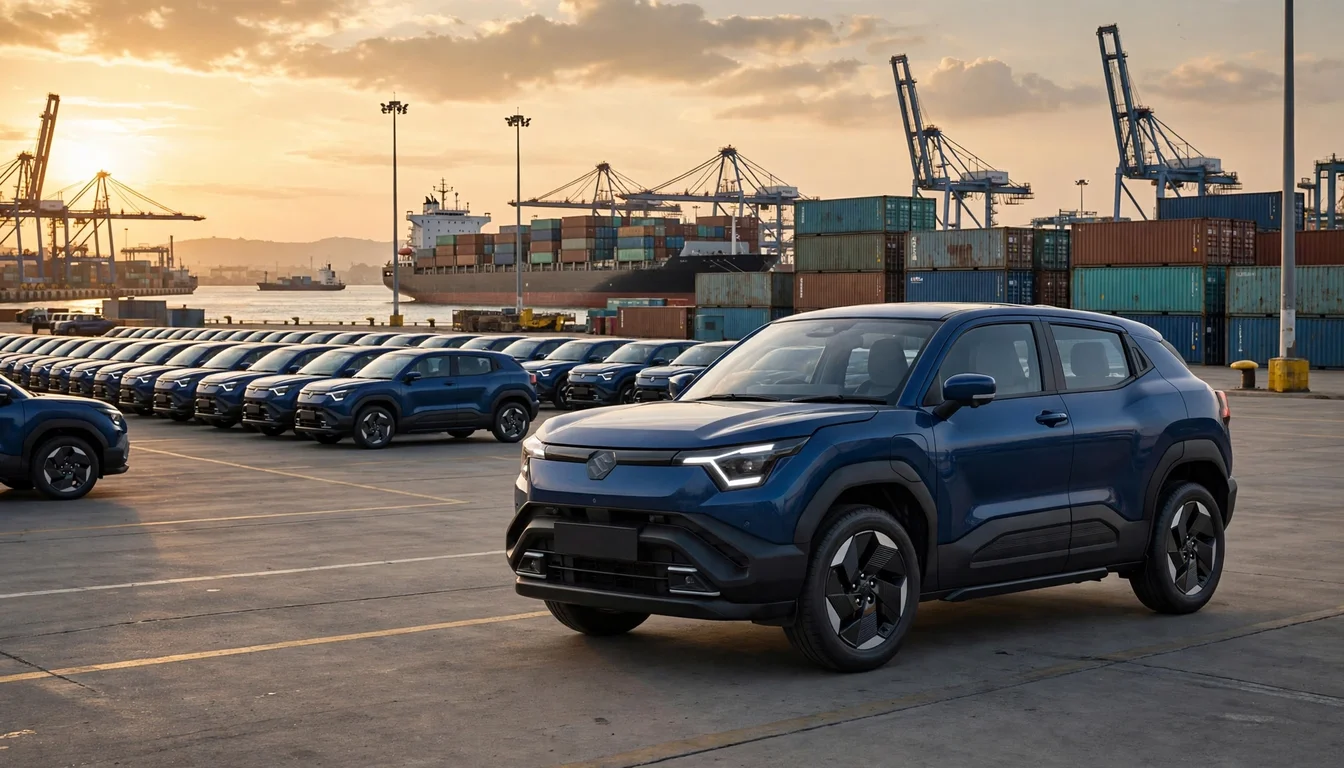
Maruti Suzuki has crossed a milestone that sounds like a success story and reads like a puzzle. On 29 October 2026, the company said cumulative exports of its made-in-India electric SUV, the e VITARA, have passed 50,000 units since global shipments began in August 2025. Yet fewer than 12,000 have been sold in India since its February 2026 launch, and September registrations were only around 1,100. Here is why the gap exists, what the car costs, and whether to buy, wait, or pick a rival.
TL;DR:
- Exports: 50,000-plus shipped from Gujarat since August 2025, to nearly 50 countries; Europe is the largest destination.
- Domestic sales: under 12,000 since February 2026; about 1,100 in September, down roughly 24% from August.
- Why the gap: designed for export first; one Hansalpur plant supplies the world.
- Price: ₹16.19–20.21 lakh ex-showroom, or from ₹10.99 lakh plus ₹3.99/km with battery rental.
- Verdict: safe and long-range, but tight supply means waiting periods and little bargaining power.
The milestone in numbers
Maruti Suzuki says it accounted for nearly 93% of India's electric passenger-vehicle exports in April–September 2026, and was already India's largest EV exporter in FY2025-26. In Q1 FY27 alone, it shipped 15,210 of India's 15,641 electric passenger vehicles; all rivals combined managed just 431.
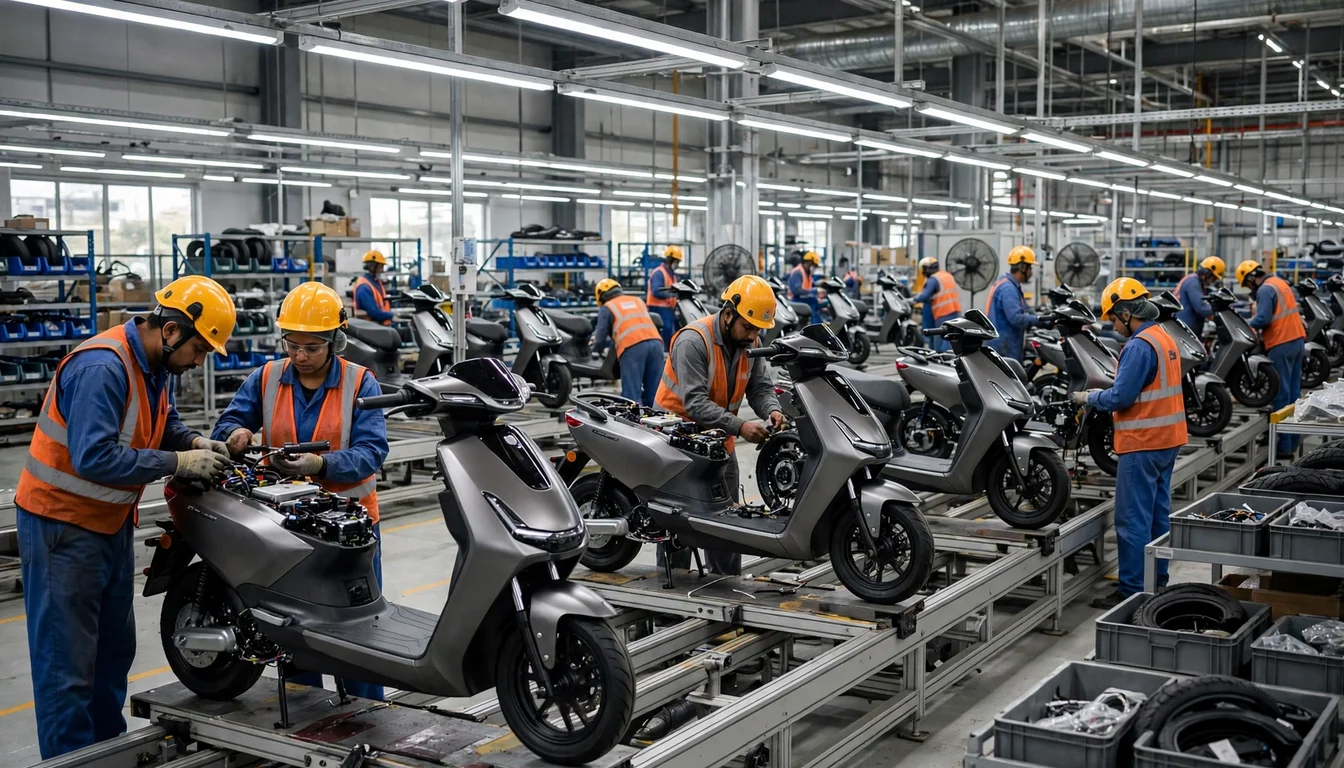
The plant matters as much as the number. The e VITARA is built only at Hansalpur in Gujarat, Suzuki's global base for its first battery-electric vehicle, recently expanded to one million vehicles a year — the first Suzuki plant anywhere at that single-location capacity — after ₹25,288.7 crore of investment. In FY2025-26 it accounted for nearly half of Maruti's overseas shipments.
At home, the market has moved fast without Maruti leading it. Electric car registrations crossed 35,000 in September 2026 for the first time, nearly double a year earlier, taking the electric share to 8.5%. Tata led with 14,792 units (42.2%), followed by Mahindra (7,782) and JSW MG (5,242). Maruti's roughly 1,100 put it far behind at home even as it dominates exports. That contrast is the real story.
Why exports run ahead of domestic sales
Four forces explain the gap — none of them is simply "Indians do not want the car."
- Export-first by design: production was flagged off in August 2025 for sale in over 100 countries, months before the February 2026 Indian launch. Europe got the first cars and remains the largest destination. When one plant serves contracted exports and a domestic order book, the domestic side flexes.
- A late domestic start: with Indian sales beginning only in February 2026, Maruti's tally was always going to look small next to rivals with full-year line-ups. Between January and May 2026, domestic sales were about 7,097 against over 35,000 exports.
- Capacity is fought over inside Maruti too: domestic supply stayed tight while CNG demand surged, touching 78,000 units in May 2026. A new Kharkhoda plant in Haryana (production from May 2026, 2.5 lakh units a year) helps the network but does not instantly free up e VITARA output.
- A premium, Nexa-only pitch: the car is sold only through Nexa showrooms in the ₹16–20 lakh band. Interest is not the constraint: CarDekho Group reported this band drew the largest EV research share (26.6%) during Navratri and Dussehra 2026, with enquiries 40% higher after the festival.
The September dip reads less like a demand collapse than an allocation decision: a collapse would show up as discounting and cars piling up at dealers, and neither has happened.
What Indian buyers actually get
These are the figures that matter (Indian auto portals, October 2026):
- Price (ex-showroom, with battery): ₹16.19 lakh (Delta) to about ₹20.21 lakh (Alpha dual-tone). Mumbai on-road: roughly ₹17.2–21.41 lakh.
- Battery rental (BaaS): from ₹10.99 lakh plus ₹3.99 per km (smaller battery), and from ₹11.99 lakh plus ₹4.39 per km (larger battery, Zeta). It cuts the upfront price but adds a per-km charge, so check it against your annual running.
- Range: 49 kWh, claimed 440 km; 61 kWh, claimed 543 km. Real-world estimates: roughly 300–350 km and 380–420 km respectively.
- Power: about 143 hp (49 kWh) and about 173 hp (61 kWh), both with 193 Nm. There is no petrol, diesel or CNG version.
- Charging: DC fast charging, 10–80% in about 45 minutes. On a 7.4 kW home charger, 10–100% takes about 6.5 hours (49 kWh) or 9 hours (61 kWh).
- Safety, warranty, buyback: five-star Bharat NCAP, seven airbags, Level-2 assistance on higher variants, 8-year/1,60,000 km battery warranty, and assured buyback up to 60% after three years or 45,000 km (50% after four years/60,000 km).
- Running cost: at ₹8 per unit at home, a full 61 kWh charge costs about ₹488 for roughly 380–420 km (₹1.20–1.30/km). At an illustrative ₹20 per unit on public DC charging, it costs about ₹1,220 (₹2.90–3.20/km).
Should you buy now, wait, or pick a rival?
It depends on your timeline more than on the car's quality.
- Buy now if: you value Maruti's service network, the safety rating and the buyback promise, you can charge at home, and you will accept a waiting period instead of a discount. The 61 kWh Zeta is the sweet spot: full 543 km claimed range, still under ₹20 lakh ex-showroom.
- Wait if: your purchase is not urgent. Domestic allocation should improve as Hansalpur's expanded capacity feeds both markets, and waiting may bring year-end offers.
- Cross-shop the Tata Curvv EV if: you want a bigger boot, a roomier cabin, or quicker delivery. Its top variants cost close to the e VITARA Alpha (around ₹19.99 lakh for the Accomplished+ S), it claims 502 km, and comparisons praise its ride and space while noting the e VITARA's longer claimed range and service advantage. Drive both back to back.
- Skip battery rental at high mileage: at ₹3.99–4.39 per km, 20,000 km a year costs roughly ₹80,000–88,000 a year in rental alone. Low-mileage users benefit most; heavy users should buy the battery outright.
For the industry, the test of the next two quarters is simple: do October–December registrations show domestic allocation rising, or does the export share stay near 93%? Judge the car on price, range, charging and warranty, not its export trophy.
Frequently Asked Questions
Why are Maruti e VITARA domestic sales so low despite 50,000 exports?
Because the car was built for export first. Shipments began in August 2025, Indian sales only in February 2026, and the single Hansalpur plant serves nearly 50 countries under commitments that dwarf domestic volumes. The gap reflects allocation and a late start, not weak interest: festive EV enquiries were 40% higher after Navratri 2026 than before it.
What is the Maruti e VITARA price in India?
Ex-showroom with battery included: ₹16.19 lakh (Delta) to about ₹20.21 lakh (Alpha dual-tone), as listed in October 2026. With battery rental, from ₹10.99 lakh plus ₹3.99 per km. Mumbai on-road listings: roughly ₹17.2–21.41 lakh.
What is the real-world range of the Maruti e VITARA?
Claimed range is 440 km (49 kWh) and 543 km (61 kWh). Independent estimates suggest roughly 300–350 km and 380–420 km respectively in mixed driving; city driving does better than sustained highway speeds, where range falls fastest.
Is the Maruti e VITARA worth buying over the Tata Curvv EV?
Choose the e VITARA for Maruti's service network, five-star safety, the longest claimed range in the pair (543 km vs 502 km) and buyback up to 60% after three years. Choose the Curvv EV for a bigger boot, a roomier cabin, or quicker delivery. A back-to-back test drive is the deciding step.
Does the Maruti e VITARA come with a battery rental option, and what does it cost?
Yes. Under Battery as a Service, it starts at ₹10.99 lakh plus ₹3.99 per km (smaller battery); the larger-battery Zeta starts at ₹11.99 lakh plus ₹4.39 per km. Low-mileage users benefit most; high-mileage drivers should compare the multi-year total against buying outright.
People also search for
- E Vitara Zeta on road price
- E Vitara 61 kWh on Road Price
- Maruti e Vitara battery price
- E Vitara range
- E Vitara Alpha on-road price
- E Vitara launch date in India
- E Vitara battery price in India
- E Vitara Zeta price
Sources & References
- ETAuto, "Maruti Suzuki Achieves Milestone of 50,000 EV Exports, Dominating India's Electric Vehicle Market" — https://auto.economictimes.indiatimes.com/news/passenger-vehicle/maruti-suzuki-crosses-50000-ev-exports-accounts-for-93-of-indias-electric-pv-shipments/135291779
- The Hindu BusinessLine, "Maruti Suzuki achieves exports of 50,000 EVs since August 2025" — https://www.thehindubusinessline.com/companies/maruti-suzuki-achieves-exports-of-50000-evs-since-august-2025/article71639394.ece
- NDTV Auto, "Maruti Suzuki e-Vitara EV Exports Cross 50,000 Units In Over A Year" — https://www.ndtv.com/auto/maruti-suzuki-e-vitara-ev-exports-cross-50-000-units-in-over-a-year-12253451/amp/1
- Business Standard, "Maruti Suzuki India's EV exports cross 50,000 units since August 2025" — https://www.business-standard.com/amp/companies/news/maruti-suzuki-india-s-ev-exports-cross-50-000-units-since-august-2025-126102900534_1.html
- Financial Express, "Maruti's EV exports cross 50,000, domestic sales below 12,000" — https://www.financialexpress.com/auto/car-news/marutis-ev-exports-cross-50000-domestic-sales-below-12000/4372490/
- CarWale, "Maruti Suzuki e Vitara Price" — https://www.Carwale.com/maruti-suzuki-cars/e-vitara/
- Autocar India, "Maruti Suzuki e Vitara Range" — https://www.autocarindia.com/cars/maruti-suzuki/e-vitara/range
- CarDekho, "5 EVs Under Rs 20 Lakh With Highest Claimed Range" — https://www.cardekho.com/news/general/want-a-longrange-ev-with-more-than-400-km-range-under-rs-20-lakh-here-are-5-options-to-consider-this-diwali-36817.htm